Trafford Regeneration: The £7bn Story Reshaping South Manchester

By Ethan Wu, Senior Marketing Executive
12 June 2026 · 13 min read
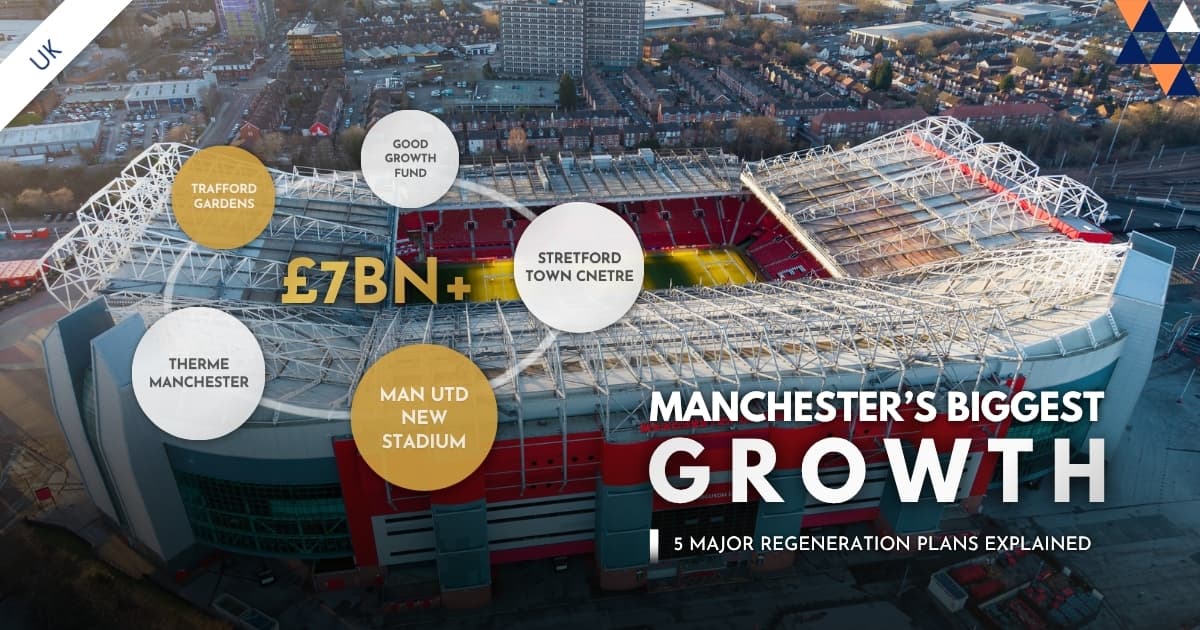
Greater Manchester's biggest growth story isn't where most investors are looking. While headlines focus on city-centre apartments and Ancoats regeneration, Trafford, the borough that wraps around Manchester's south-west, is quietly absorbing the largest concentration of regeneration investment in the UK outside London.
Five major projects, all confirmed and either underway or with planning consent, are reshaping Trafford over the next 15 years. Their combined headline value is more than £7 billion. They include Manchester United's new 100,000-seat stadium, Europe's largest wellbeing resort, an 800-home town-centre rebuild, and a 150-hectare masterplan that adds 17,000 new homes and 92,000 jobs to South Manchester.
This is the master summary of what's actually happening: the verified numbers, the realistic timelines, and the honest investor read.
Key Takeaways
- £7bn+ Combined Investment: Five major Trafford regeneration projects with a combined development value exceeding £7 billion are confirmed and underway.
- 17,000 New Homes: The Trafford Wharfside masterplan alone will deliver 17,000 homes alongside 92,000 jobs across a 150-hectare site adjacent to Old Trafford.
- Already Delivering: Trafford Gardens (149 apartments) is completed, Stretford Town Centre is in construction, and Therme Manchester opens late 2028.
- 15-Year Horizon: The Manchester United stadium completes 2030–32, with the Wharfside masterplan playing out across 15 years. A long-term play, not short-term arbitrage.
Jump to section:
1. What the £7bn Headline Actually Means
The £7bn figure that gets quoted for Trafford regeneration projects deserves an honest breakdown before we get into the projects themselves. £7bn reflects total planned development value across all five projects over the 15-year horizon. Of that, around £5 billion represents distinct capital commitments confirmed to date. The remainder is forward development value within the Trafford Wharfside masterplan.
Watch: Trafford Regeneration Story in 60 Seconds
Trafford regeneration overview, July 2026
That distinction matters because it sets a realistic expectation: this is a long-term story, not a step-change that arrives in 2026. The capital is real, the planning consents are real, but the delivery curve runs into the early 2030s.
Here's the headline summary before we go deeper:
For broader Manchester context and how Trafford fits within the Greater Manchester investment picture, see our Manchester area guide.
Quick FAQ:
Q: Why is Trafford attracting this much investment?
A: Three factors aligning at once: world-class existing infrastructure, strong public-private partnership, and land availability for major development. Most UK regeneration stories have one or two. Trafford has all three.
2. Manchester United Stadium & Trafford Wharfside
Manchester United has confirmed plans to build an entirely new 100,000-seat stadium adjacent to the current Old Trafford ground. Designed by Foster + Partners and privately funded (no public money), it will be the largest football stadium in the UK and one of the largest in Europe.
The stadium itself is only the centrepiece. The wider Trafford Wharfside masterplan is a 150-hectare urban transformation with an estimated development value of £4.2 billion, designed by Allies & Morrison, SLA, Civic and JLL.
| Stadium cost | ~£2 billion (privately funded) |
| Wider masterplan value | £4.2 billion (Trafford Wharfside total) |
| Stadium capacity | 100,000 seats, largest in the UK |
| Architect | Foster + Partners (Norman Foster) |
| Masterplan area | 150 hectares |
| New homes | 17,000+ across Trafford Wharfside |
| Jobs created | 92,000 (Oxford Economics) |
| Annual GDP contribution | £7.3bn UK / £5.0bn Greater Manchester |
| Stadium completion | Target 2030–31 season (may slip to 2032) |
| Masterplan horizon | 15 years from adoption |
What the masterplan actually covers
The 150-hectare site is split into distinct quarters: Heritage Quarter, Trafford Wharf, Wharfside Heart, and Innovation Quarter. Collectively they will deliver:
- 17,000+ new homes across a mix of tenures
- Major commercial and workspace development
- Cultural and leisure facilities (Imperial War Museum North sits within the area)
- Enhanced rail and road connections between Trafford Wharfside and Manchester city centre
- Significant public realm and green-space improvements
The economic impact (Oxford Economics)
An independent Oxford Economics report found that the full regeneration could generate £7.3 billion per year in GDP contributions to the UK economy, supporting nearly 92,000 jobs. Of that, £5.0 billion and 62,000 jobs would arise within Greater Manchester specifically.
Important framing: the £7.3 billion figure is annual economic impact, not the build cost. The stadium itself costs ~£2 billion; the wider Wharfside masterplan carries an estimated £4.2 billion development value. These are the capital investment figures. The £7.3 billion is the ongoing economic activity those investments generate.
Government backing
Greater Manchester Mayor Andy Burnham has designated the area as a Mayoral Development Area. Chancellor of the Exchequer Rachel Reeves publicly backed the regeneration in January 2025. Despite the government support, the stadium and surrounding core development are entirely privately funded, with no public subsidy required.
Where the project faces challenges
Honest framing matters here. As of mid-2026, the stadium project has real delivery risk. Rising construction costs may push the bill beyond £3 billion, design work has paused at times, financing isn't fully secured, and key land parcels aren't fully under the club's control. The legal framework for the wider regeneration is still evolving, which could push back the construction start.
None of this means the project doesn't happen. It does mean investors should view the stadium-completion date as a planning target rather than a fixed delivery date.
Quick FAQ:
Q: Should I worry about the stadium slipping past 2032?
A: For property investors, less than you might think. The stadium is one part of a 15-year masterplan. The 17,000 new homes progress on their own timeline, regardless of stadium delivery.
3. Therme Manchester: Europe's Largest Wellbeing Resort
Therme Manchester is a landmark wellbeing resort being built at TraffordCity, on the former EventCity site south of the Bridgewater Canal. When complete, it will be the largest water-based wellbeing destination in Europe and the first Therme facility in the UK.
| Investment | ~£450 million |
| Site | 28 acres (11.5 hectares), TraffordCity |
| Developer | Therme Group (via Therme Horizon JV with CVC Capital Partners) |
| JV value | €1 billion (Therme Horizon, completed August 2025) |
| Construction manager | Sir Robert McAlpine |
| Expected opening | Late 2028 |
| Projected visitors | 1.7 million in year one |
| Permanent jobs | 650 full-time roles |
| Construction jobs | 2,500 (1,200 peak on-site) |
| Economic contribution | £4.5bn+ over its lifetime (53% to Greater Manchester) |
| Sustainability | LEED Platinum target, 92% water recycling, renewable energy |
3 themed zones
Therme Manchester operates across three distinct zones designed for different audiences:
- Play Zone (family): next-generation waterslides, a wave pool, warm-water pools, an indoor beach, steam rooms, saunas, family dining.
- Relax Zone (adults-only): premium indoor and outdoor pools, waterfall showers, mineral baths, steam rooms, saunas, casual dining.
- Restore Zone (adults-only): advanced health therapies, sauna rituals, experience showers, spa therapies, personalised nutrition, fine dining.
Funding and partnership
In June 2025, Therme Group announced a strategic €1 billion joint venture with CVC Capital Partners, known as Therme Horizon, providing financial backing for Therme Manchester and a global pipeline of future resorts. The deal completed in August 2025 after regulatory approvals.
For context: the Trafford Centre next door already attracts 30 million visits per year. Therme Manchester adds 1.7 million projected visitors to an area already established as one of the UK's biggest leisure destinations.
The investor implication
Therme Manchester does something Manchester city-centre regeneration doesn't: it makes Trafford a destination. 650 permanent jobs create direct rental demand. 1.7 million annual visitors create indirect demand across hospitality, retail and transport. The combination is the kind of amenity uplift that typically lifts surrounding property values over a 5–10 year horizon, similar to what MediaCity did for Salford Quays.
4. Stretford Town Centre Regeneration
The Stretford Town Centre regeneration is a joint venture between Bruntwood and Trafford Council to transform the former Stretford Mall and surrounding area into a vibrant new neighbourhood. The masterplan delivers up to 800 new homes across multiple phases, alongside new public spaces, retail, leisure and improved connectivity.
| Total homes planned | Up to 800 |
| Total pipeline value | ~£175 million+ |
| Developers | Bruntwood and Trafford Council (JV) |
| Current phase (Plot 2A) | 248 build-to-rent apartments (up to 12 storeys) |
| Plot 2A contractor | Graham (£60m contract, awarded April 2026) |
| Good Growth Fund allocation | £23.9m for Stretford (part of £113m Trafford total) |
| King Street transformation | Completed August 2025 |
| Planning status | Outline approved; Plot 2A full application submitted |
Phasing and timeline
The masterplan is being delivered in phases:
- Phase 1 (King Street): completed August 2025 with new streetscape, improved connectivity, retail and leisure additions.
- Plot 2A (current): 248 build-to-rent apartments with ground-floor commercial space. Graham appointed as contractor in April 2026. Construction commencing 2026.
- Plots 2B and 2C (future): additional residential phases covering the remaining homes in the 800-unit masterplan. Plot 2B estimated £45m, Plot 1 estimated £70m. Still to be procured.
- Affordable housing: 178 affordable homes planned, subject to further funding milestones.
Good Growth Fund backing
In March 2026, Trafford Council announced it had secured £113 million through Greater Manchester Mayor Andy Burnham's Good Growth Fund. Of this, £23.9 million is earmarked for Stretford Town Centre specifically. A further £26 million had already been allocated in November 2025 for housebuilding in the wider Old Trafford area, enabling 382 new homes at Trafford Wharf.
The £113 million package also includes £89.1 million for transport investment in New Carrington, covering a 4km relief road, better buses, and active travel routes supporting 5,000 new homes and 4,000–5,300 jobs.
Quick FAQ:
Q: What does "build-to-rent" mean for individual investors?
A: Plot 2A apartments are institutional rental stock, not sold individually. The relevance for investors is signalling: build-to-rent at scale confirms professional confidence in Stretford's rental demand, which lifts surrounding privately-owned stock.
5. What's Already Delivering: Trafford Gardens
Most Trafford regeneration headlines focus on what's coming. Trafford Gardens is what's already arrived: a completed 149-apartment development by Linear Group on Talbot Road, 300m from Old Trafford Metrolink. It's the first proof point that the Trafford story is delivering, not just planning.
| Developer | Linear Group (Linear Living) |
| Location | Talbot Road, Trafford, 300m from Old Trafford Metrolink |
| Unit types | 1-bed, 2-bed and 3-bed apartments |
| Building | 13-storey block |
| Total value | £34 million |
| Phase 1 | 33 affordable homes (Irwell Valley Homes, rent-to-buy) |
| Phase 2 | 116 homes for private sale from £220,000 |
| Amenities | Rooftop garden, private courtyard |
| Status | Completed |
Trafford Gardens sits on the same Talbot Road corridor that connects directly to the Trafford Wharfside masterplan area and the future Manchester United stadium. For investors, this matters because the development is already income-generating in the path of billions of pounds of planned investment. It's the asset class that captures regeneration uplift without the multi-year construction wait.
6. The Operational Layer: Managing Trafford Stock
Regeneration projects deliver buildings. Property management turns buildings into income. For investors entering Trafford, the operational layer matters as much as the capital story, particularly for overseas buy-to-let investors and time-poor UK buyers who don't want hands-on management.
Rothmore's sister company, CasaCity, provides end-to-end management across Trafford and the wider Manchester market. The service covers tenant sourcing, rent collection, maintenance, compliance certification (Gas Safety, EICR, EPC), and 24/7 emergency support. CasaCity manages both traditional long-term lets and short-term serviced accommodation, with management fees of 10%+VAT and 17.5%+VAT respectively.
The reason this matters in a Trafford-specific article: the area's demand pattern is mixed. Stadium and Therme footfall create short-stay demand. The 17,000 new homes create long-term rental demand. Investors who can flex between letting strategies, long-let when long-let is stronger and short-let when short-let yields better, capture more of the regeneration upside than investors locked into a single strategy.
7. How Investors Should Position Now
Three practical takeaways for investors considering Trafford exposure:
Buy completed or near-completed stock in the regeneration corridor
The Trafford Wharfside masterplan plays out over 15 years. The Manchester United stadium completes in 2030–32 at the earliest. Investors who wait for the regeneration to "finish" before buying will pay the regenerated price. Investors who buy completed stock in the path of the regeneration now, like Trafford Gardens on Talbot Road, capture the uplift as it happens.
Think in 7–15 year horizons, not 12–24 months
Honest framing matters. Comparable Greater Manchester regenerations such as Salford Quays, MediaCity and Ancoats took 10–15 years to deliver the value uplift investors associate with them today. Trafford is at a comparable starting point. Investors expecting quick capital growth should look elsewhere; investors with patience are entering at the right end of the curve.
Track Metrolink proximity above all else
The single best predictor of where Trafford regeneration value lands is Metrolink station proximity. The Old Trafford, Wharfside, and Trafford Bar stops sit at the heart of the regeneration zone. Properties within 5–10 minutes' walk of these stops will capture the regeneration uplift first.
Quick FAQ:
Q: Is Trafford right for a first-time UK property investor?
A: It can be, with eyes open on the time horizon. First-time investors wanting current rental performance may prefer central Manchester or Birmingham. Trafford suits patient, thesis-driven buyers.
Explore Trafford with Rothmore Property
Trafford represents one of the largest regeneration concentrations in UK property right now. Rothmore Property works with investors across all five projects' surrounding postcodes, sourcing completed stock in the regeneration corridor, advising on long-term positioning, and connecting buyers with the right developer-direct opportunities.
Browse our Manchester new-build developments for current Trafford-corridor stock, or get in touch with our team to discuss where Trafford fits within a broader Manchester investment strategy.
Frequently Asked Questions
Common questions about Trafford regeneration and what it means for property investors.
Trafford suits investors with a 7–15 year horizon and a thesis-driven view on regeneration delivery. Five major projects worth £7bn+ are confirmed and underway, including Manchester United's new stadium, Therme Manchester, and the 800-home Stretford Town Centre rebuild. Properties bought now in the Trafford Wharfside corridor, particularly near Metrolink stations, are positioned to capture regeneration uplift as it happens.
Ethan Wu
Senior Marketing Executive
Ethan is a Marketing Executive at Rothmore Property, bringing 4 years of experience spanning above-the-line marketing strategy, graphic design, and data-driven campaign analysis. Holding a Bachelor's degree in Marketing, Ethan oversees the full end-to-end marketing function at Rothmore — from market research and strategic planning through to creative production, campaign execution and performance reporting.
His analytical approach and design capability ensure every campaign is both visually compelling and grounded in measurable results, helping Rothmore maintain a consistent and impactful presence across all channels.
How can Rothmore Property help?
Whether you're an investor or a homeowner, Rothmore Property provides expert guidance, market insights, and tailored solutions to support your property purchase.


