Mayors Can Now Overrule Planning Committees on Major Developments in 13 Regions

By Ethan Wu, Senior Marketing Executive
25 August 2026 · 6 min read
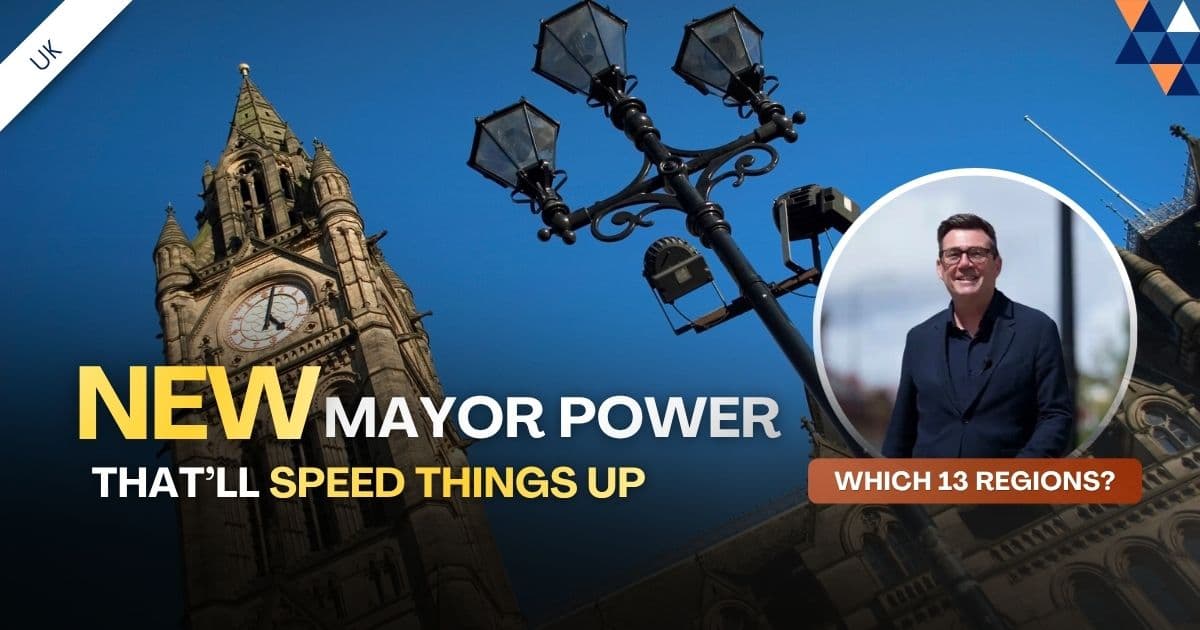
The government has confirmed that elected mayors across 13 English regions will gain the power to call in and decide major planning applications, overruling local council committees for the first time outside London.
Key Takeaways
- Call-in powers confirmed: Elected mayors in 13 English regions can now intervene on major planning applications, overruling local committee decisions under the English Devolution and Community Empowerment Act 2026.
- Three clear thresholds: Applications involving 150 or more homes, 15,000 square metres of commercial space, or buildings above 30 metres in height are eligible for mayoral call-in.
- Legislation already passed: Section 33 and Schedule 14 of the Act provide the legal framework, with secondary legislation and a formal consultation expected by September 2026.
- Manchester and Liverpool in scope: Both Greater Manchester and Liverpool City Region are among the 13 mayoral strategic authorities gaining these powers, with direct implications for large-scale regeneration projects.
Jump to section:
What the New Mayoral Planning Powers Do
The English Devolution and Community Empowerment Act 2026 introduced two distinct mechanisms for mayoral intervention in the planning system. The first is a call-in power, where the mayor takes over and determines a planning application directly. The second is a direction to refuse, where the mayor instructs the local authority to reject an application.
Both tools are designed to ensure that developments of strategic importance are not blocked at the local committee level when they align with regional housing and growth targets. The powers sit within Section 33 and Schedule 14 of the Act, which has already received Royal Assent.
This is not entirely without precedent. The Mayor of London has operated a similar call-in mechanism since 2008 under the Town and Country Planning (Mayor of London) Order 2008. Sadiq Khan has used these powers to approve major housing schemes that borough councils either refused or delayed. The new framework extends a version of this model to every mayoral strategic authority in England.
It is worth noting that these powers are not yet operative. A formal consultation is expected in the coming weeks, with secondary legislation needed before mayors can begin exercising the call-in function in practice.
Quick FAQ:
Q: Can a mayor approve any planning application they want?
A: No. The powers are limited to applications that meet specific size thresholds. Smaller residential schemes and most commercial applications remain under the sole jurisdiction of local planning committees. The mayor can only intervene on applications that cross the threshold.
Get Our Weekly Property Market Update
Rothmore sends fresh UK property investment opportunities straight to your inbox: off-market deals, exclusive offers and access to new-launch projects. Be the first to know, every week.
Register for weekly updates here

The Three Thresholds for Call-In
The proposed national thresholds are clear-cut. An application becomes eligible for mayoral call-in if it meets any one of the following criteria:
| Threshold | Detail |
|---|---|
| Residential | 150 or more homes |
| Commercial | 15,000 square metres or more of floor space |
| Height | Any building above 30 metres |
These thresholds mirror those used by the Mayor of London, who recently added a streamlined category for schemes of 50 or more homes where the borough intends to refuse. Whether English mayors outside London will adopt a similar lower tier remains to be seen during the consultation.
For context, 150 homes is a relatively high bar. According to analysis by Planning Geek, practitioners should not treat these thresholds as operative until the secondary legislation is formally laid. The consultation will determine whether the thresholds are set nationally or varied by region.
The height threshold of 30 metres (roughly 8-10 storeys) is particularly relevant for city centre schemes in Manchester and Liverpool, where mid-rise and tall building proposals are central to the current pipeline.
Quick FAQ:
Q: Do these thresholds apply to developments already in the planning process?
A: Not yet. The thresholds are proposed and subject to consultation. Existing live applications will not be affected retrospectively. The call-in powers only become operative once secondary legislation is laid and commencement orders are issued.
Which 13 Regions Are Affected
The call-in powers apply to all 13 mayoral strategic authorities (MSAs) established or in formation under the English Devolution framework. The full list:
| # | Mayoral Strategic Authority |
|---|---|
| 1 | Greater Manchester |
| 2 | Liverpool City Region |
| 3 | West Midlands |
| 4 | West of England |
| 5 | North East |
| 6 | South Yorkshire |
| 7 | West Yorkshire |
| 8 | York and North Yorkshire |
| 9 | Hull and East Yorkshire |
| 10 | Greater Lincolnshire |
| 11 | Cambridgeshire and Peterborough |
| 12 | East Midlands |
| 13 | Tees Valley |
This covers a significant share of England's population and economic output outside London. Ten of the 14 MSA mayors reportedly backed the proposals during early discussions, according to reporting from Planning Geek.
For property investors, the geography matters. Every major city where Rothmore operates, including Manchester, Liverpool, Birmingham (West Midlands), and Leeds (West Yorkshire), now falls under a mayoral authority with potential call-in powers over large schemes.
Explore Manchester's Best Investment Areas
Explore our full Manchester area guide, it provides property investors with a side-by-side breakdown of the 6 best districts, giving investors a clear picture about the city.

What This Means for Manchester and Liverpool
Greater Manchester and Liverpool City Region are two of the most active development markets outside London, and both are led by mayors with stated pro-growth agendas.
Andy Burnham has championed schemes such as the Water Street regeneration and the Trafford Wharfside masterplan. Under the new powers, if a local committee were to refuse a qualifying scheme that the mayor considers strategically important, Burnham could call it in and approve it directly.
Steve Rotheram's Liverpool City Region has a similarly large pipeline, including the North Docks regeneration and the Liverpool Central regeneration programme. These are exactly the types of large-scale, multi-building schemes that could meet the 150-home or 30-metre thresholds.
The practical effect is a faster route to approval for strategic projects. Where a local committee might delay or refuse on neighbourhood-level grounds, the mayor can intervene if the scheme aligns with regional growth targets. This is particularly relevant given the government's housing delivery ambitions under the revised National Planning Policy Framework (NPPF), which sets higher housing targets and introduces grey belt land release as a new policy tool.
The NPPF and these mayoral powers are different instruments working toward the same goal. The NPPF is national planning policy that sets housing targets and development priorities. The mayoral call-in powers are a devolution mechanism that gives regional leaders the authority to enforce those targets when local decisions fall short. Together, they represent the strongest planning reform package in a generation.
Quick FAQ:
Q: Does this mean Manchester and Liverpool will see more high-rise developments approved?
A: Potentially. The 30-metre height threshold means any building above roughly 8-10 storeys qualifies for mayoral call-in. In city centre locations where tall buildings are already part of the established character, a mayor with a pro-growth stance is more likely to approve than a local committee facing neighbourhood opposition.

The Local Democracy Debate
Not everyone supports the shift. Critics argue that giving mayors the power to override elected local committees undermines democratic accountability. Planning decisions are often contentious at the neighbourhood level, involving issues such as building height, density, traffic impact, and character of an area. Removing the final say from locally elected councillors concentrates that decision-making in a single regional figure.
Supporters counter that local committees sometimes block developments that serve wider regional needs, particularly housing. When a council refuses a 200-home scheme on a brownfield site due to local opposition, but the region has a housing shortfall of thousands of units, the strategic case for intervention is straightforward.
The consultation expected in the coming weeks will be the key moment. It will determine whether thresholds are fixed nationally or adjusted by region, whether mayors must demonstrate strategic justification before calling in an application, and what safeguards exist for community representation in the call-in process.
For investors, the direction of travel is clear regardless of where the consultation lands on detail. The government is building a planning system where strategic housing delivery takes priority, and regional mayors are the chosen instrument for enforcing that priority.
This aligns with the broader NPPF reforms already in force, which raised housing targets and introduced mandatory housing delivery testing. The mayoral call-in powers add an enforcement layer that the NPPF alone did not provide.
Quick FAQ:
Q: Could a mayor use these powers to block a development rather than approve it?
A: Yes. The Act includes a "direction to refuse" mechanism alongside the call-in power. A mayor could instruct a local authority to refuse an application if it conflicts with regional strategic priorities, though the primary stated purpose of the powers is to unblock housing delivery.
Explore: The Hallmark, Manchester
A landmark residential tower in Manchester's Greengate neighbourhood, offering apartments with panoramic city views. Located within walking distance of the city centre and Victoria station, the scheme sits in one of the areas most likely to benefit from accelerated planning under the new mayoral powers.
The Bottom Line
The mayoral planning call-in powers represent the most significant change to English planning governance since the Localism Act 2011, and they tilt the system firmly toward delivery. For property investors looking at Manchester, Liverpool, Birmingham, or Leeds, the practical effect is greater certainty that large-scale schemes meeting regional growth targets will progress, even where local opposition exists. The consultation detail matters, but the direction is set.
Related Reading
The bigger picture matters, three related pieces:
- New NPPF 2026: Key Changes to the Planning System - The national planning policy framework that sets the housing targets these mayoral powers are designed to enforce.
- Housing Delivery Test Explained 2026 - How councils are measured on housing delivery, and what happens when they fall short.
- Liverpool North Docks MDC Regeneration - One of the largest schemes in the Liverpool City Region pipeline, and exactly the type of project the new call-in powers could affect.
Fresh UK property market updates for investors - regeneration, yields, tax rules and monthly rental data, all in one hub. Read the latest here.

This article discusses legislation and planning policy for informational purposes only. Rothmore Property does not provide legal or planning advice. For guidance on how planning decisions may affect a specific property or development, seek advice from a qualified planning consultant or solicitor.
Common questions about the new mayoral planning call-in powers, the thresholds that trigger them, and what they mean for property investors in England's 13 devolved regions.
The legislation has received Royal Assent, but the powers are not yet operative. Secondary legislation needs to be laid, and a formal consultation on the thresholds and process is expected in the coming weeks. Practitioners should not treat the thresholds as an active call-in test for live applications until commencement orders are issued.
Ethan Wu
Senior Marketing Executive
Ethan is a Marketing Executive at Rothmore Property, bringing 4 years of experience spanning above-the-line marketing strategy, graphic design, and data-driven campaign analysis. Holding a Bachelor's degree in Marketing, Ethan oversees the full end-to-end marketing function at Rothmore — from market research and strategic planning through to creative production, campaign execution and performance reporting.
His analytical approach and design capability ensure every campaign is both visually compelling and grounded in measurable results, helping Rothmore maintain a consistent and impactful presence across all channels.
How can Rothmore Property help?
Whether you're an investor or a homeowner, Rothmore Property provides expert guidance, market insights, and tailored solutions to support your property purchase.


