Three NW Councils Fail the Housing Delivery Test: What Changes Now

By Ethan Wu, Senior Marketing Executive
20 August 2026 · 7 min read
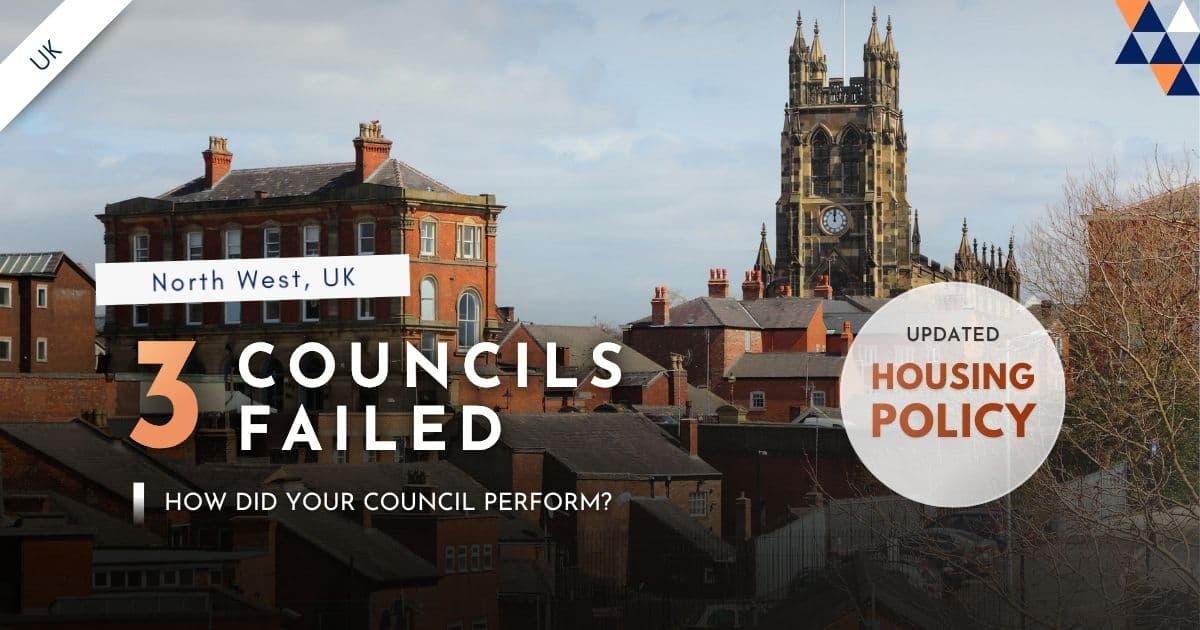
Three North West councils have just lost control of their own planning decisions, and the implications for housing supply across the region are immediate.
Key Takeaways
- Three Councils Failed: Stockport (43%), Lancaster (48%) and Chorley (63%) all scored below the 75% Housing Delivery Test threshold, triggering the harshest planning penalty available.
- Presumption Now Applies: All three must now apply a presumption in favour of approving residential planning applications, effectively overriding local policy objections on unprotected sites.
- Wider NW Underperformance: Manchester (75%) and Trafford (83%) also underperformed their targets, requiring action plans and a 20% buffer on housing land supply.
- Developer Opportunity: Sites previously blocked by local planning resistance in these boroughs now face a materially lower bar for approval, particularly in Stockport where the council has just 1.95 years of housing land supply.
Jump to section:
What the Housing Delivery Test Measures
The Housing Delivery Test is a government measure that compares the number of homes a council actually delivers against the number it should have delivered over a rolling three-year period. The result is expressed as a percentage.
Watch: Housing Delivery Test 2026 in 60 Seconds
Three NW councils fail the Housing Delivery Test, what the presumption means for planning, August 2026
Three penalty thresholds apply. Councils delivering below 95% must produce an action plan explaining how they will boost delivery. Below 85%, a 20% buffer is added to their five-year housing land supply requirement, making it harder to demonstrate sufficient pipeline. Below 75%, the council effectively loses planning control: the NPPF's presumption in favour of sustainable development overrides local policies.
The 2026 results, covering the period from April 2022 to March 2025, were published on 17 August 2026. Three North West authorities fell below the 75% line.
Quick FAQ:
Q: How often is the Housing Delivery Test published?
A: The government publishes results annually, typically in the summer. Each test covers a rolling three-year period of housing completions measured against the council's housing requirement for those same years.
Get Our Weekly Property Market Update
Rothmore sends fresh UK property investment opportunities straight to your inbox: off-market deals, exclusive offers and access to new-launch projects. Be the first to know, every week.
Register for weekly updates here >

The Three Councils That Failed
All three councils scored below 75%, the threshold that triggers the most severe penalty under the Housing Delivery Test framework.
Stockport: 43%
The worst performer of the three. Stockport delivered just 1,457 homes against a requirement of 3,408 over the three-year period, with its best single year producing only 621 completions. The council's housing land supply position sits at an estimated 1.95 years, among the weakest in the entire North West. Stockport's draft local plan, published in October 2025, identifies 26 Green Belt sites for release to meet a government target that nearly doubled the borough's previous allocation.
Council Leader Mark Roberts stated the council is "powerless to stop it" and "vehemently disagrees" with the government's Grey Belt approach but accepts its legal obligations.
Lancaster: 48%
Lancaster delivered 612 homes against a requirement of 1,271. Cabinet Member Sue Tyldsley responded that "nationally set housing targets fail to reflect local circumstances." Lancaster is also among the North West authorities unable to demonstrate a five-year housing land supply under the new standard methodology.
Chorley: 63%
Chorley delivered 986 homes against a requirement of 1,553. The Central Lancashire Local Plan began its Regulation 19 consultation in early 2025, but the borough has failed the Housing Delivery Test in consecutive years. Chorley was previously named and shamed as "underperforming" by the then Housing Secretary.
Quick FAQ:
Q: What happens to a council that fails the Housing Delivery Test two years in a row?
A: The penalty resets each year based on the latest three-year rolling average. A council that fails below 75% in consecutive years remains subject to the presumption until its delivery rate improves above the threshold. There is no additional escalation beyond the presumption.
Free Property Investment Calculators
Run the numbers before you commit. Our free stamp duty, ROI, mortgage and rental yield calculators give you a clearer picture in seconds.

What the Presumption Means in Practice
The presumption in favour of sustainable development, often called the "tilted balance," changes the default planning outcome. Instead of councils weighing applications against local policy, permission should be granted unless the harm from a scheme "significantly and demonstrably" outweighs the benefits.
In practical terms, this means residential applications on unprotected sites in Stockport, Lancaster and Chorley now face a materially lower bar for approval. Councils can still refuse, but only where protective policies apply (Green Belt, heritage, flood risk) or where adverse impacts clearly outweigh the benefits of delivering homes.
For developers, this creates a stronger position on appeal. Applications that might have been refused on local policy grounds now carry stronger prospects at the Planning Inspectorate. The 20% buffer requirement, which took effect from July 2026, compounds the pressure by requiring affected councils to demonstrate six years of housing supply instead of five.
The December 2024 NPPF raised the bar further by requiring a "strong reason" rather than a "clear reason" for refusal under protective policies, tightening the test even for sites where councils might historically have found grounds to refuse.
Quick FAQ:
Q: Can a council still refuse a planning application under the presumption?
A: Yes, but the threshold is high. Refusal requires either a protective policy (Green Belt, heritage, flood risk) providing a strong reason, or evidence that the harm from the development significantly and demonstrably outweighs the benefits. Standard local policy objections alone are not sufficient.
Wider North West Picture
The three failures sit within a broader pattern of underdelivery across the North West. Manchester scored 75% and Trafford 83%, placing both below the 85% threshold that triggers the 20% buffer requirement. Liverpool and Bolton each delivered 87%, above the buffer line but still short of the 95% action plan trigger.
Analysis by Lichfields estimates that only 40% of North West authorities can demonstrate a sufficient five-year housing land supply under the new standard methodology. Twelve authorities, including Bolton, Bury, Cheshire East, Knowsley, Lancaster, Oldham, Preston, Sefton, South Ribble, Tameside, Trafford and Warrington, are estimated to fall short.
The new standard methodology has also dramatically increased housing targets for several authorities. Burnley's requirement rose by 569%, Hyndburn by 503%, and Westmorland and Furness by 487%. Conversely, the removal of the 35% urban uplift reduced targets for Liverpool, Manchester and Salford.
Quick FAQ:
Q: Did any North West council score above 95% on the Housing Delivery Test?
A: Yes. According to Lichfields' analysis, 27 North West authorities scored 95% or higher in the previous measurement cycle. These councils avoid all three penalty tiers and are not required to produce action plans, apply buffers or accept the presumption.
What This Means for Property Investors
Three dynamics stand out for anyone watching the North West market.
First, supply constraints support rental demand. Councils that fail the Housing Delivery Test have, by definition, not built enough homes. Until delivery catches up, the supply shortfall sustains rental demand. Manchester's citywide average rental yield sits at 6.6%, and neighbouring boroughs with tighter supply often see stronger tenant competition.
Second, the planning stance has shifted. Sites that sat in planning limbo because of local resistance now have a clearer path to approval. In Stockport specifically, the council's 1.95-year housing land supply position and 43% delivery score mean the presumption applies with particular force. Stockport's average house price sits at £313,101, with gross yields reaching 6.0% in the SK1 town centre postcode.
Third, regeneration investment is accelerating. Stockport's Mayoral Development Corporation is overseeing over £1 billion of investment in the town centre, including the Stockport 8 programme targeting up to 1,300 homes. The HDT failure and the resulting presumption remove one of the remaining friction points for these schemes to progress through planning.
Explore: Tranquillity, Salford
A residential development in Salford between Manchester city centre and MediaCityUK, offering one, two and three-bedroom apartments from £222,000 with yields up to 7.0%. Completing Q4 2026, Tranquillity sits within the broader Salford regeneration corridor adjacent to Greater Manchester's underdelivering boroughs.
The Bottom Line
When a council delivers fewer than three quarters of the homes it should, the government removes its ability to say no. That is now the reality in Stockport, Lancaster and Chorley, and the ripple effects across the North West's planning landscape will shape where and how quickly new homes reach the market for years to come.
Related Reading
Context matters, three related pieces:
- New NPPF 2026: 7 Key Changes That Reshape England's Planning System - The national framework that sets the Housing Delivery Test penalties these councils now face.
- Manchester Property 2026: Prices, Rental Yields and Forecast - Current prices, rental yields and market forecasts across all Manchester districts.
- 5 Manchester Hotspots for Off-Plan Property in 2026 - Five districts with the best off-plan opportunities this year, including boroughs affected by delivery shortfalls.
Fresh UK property market updates for investors, regeneration, yields, tax rules and monthly rental data, all in one hub. Read the latest here.

Frequently Asked Questions
The Housing Delivery Test determines whether councils have built enough homes to meet government targets, and the consequences when they fall short. These questions cover how the test works, what the 2026 results mean for Stockport, Lancaster and Chorley, and how the presumption in favour of sustainable development changes the planning landscape across the North West.
The Housing Delivery Test is a government measure that compares the number of homes a local authority actually delivers against the number it should have delivered over a rolling three-year period. The result is expressed as a percentage. Councils scoring below 95% must produce an action plan, below 85% triggers a 20% buffer on housing land supply, and below 75% triggers the presumption in favour of sustainable development.
Ethan Wu
Senior Marketing Executive
Ethan is a Marketing Executive at Rothmore Property, bringing 4 years of experience spanning above-the-line marketing strategy, graphic design, and data-driven campaign analysis. Holding a Bachelor's degree in Marketing, Ethan oversees the full end-to-end marketing function at Rothmore — from market research and strategic planning through to creative production, campaign execution and performance reporting.
His analytical approach and design capability ensure every campaign is both visually compelling and grounded in measurable results, helping Rothmore maintain a consistent and impactful presence across all channels.
How can Rothmore Property help?
Whether you're an investor or a homeowner, Rothmore Property provides expert guidance, market insights, and tailored solutions to support your property purchase.


