Buying a New-Build Buy-to-Let Through a Limited Company: A 2026 UK Investor's Guide

By Ethan Wu, Senior Marketing Executive
16 June 2026 · 6 min read

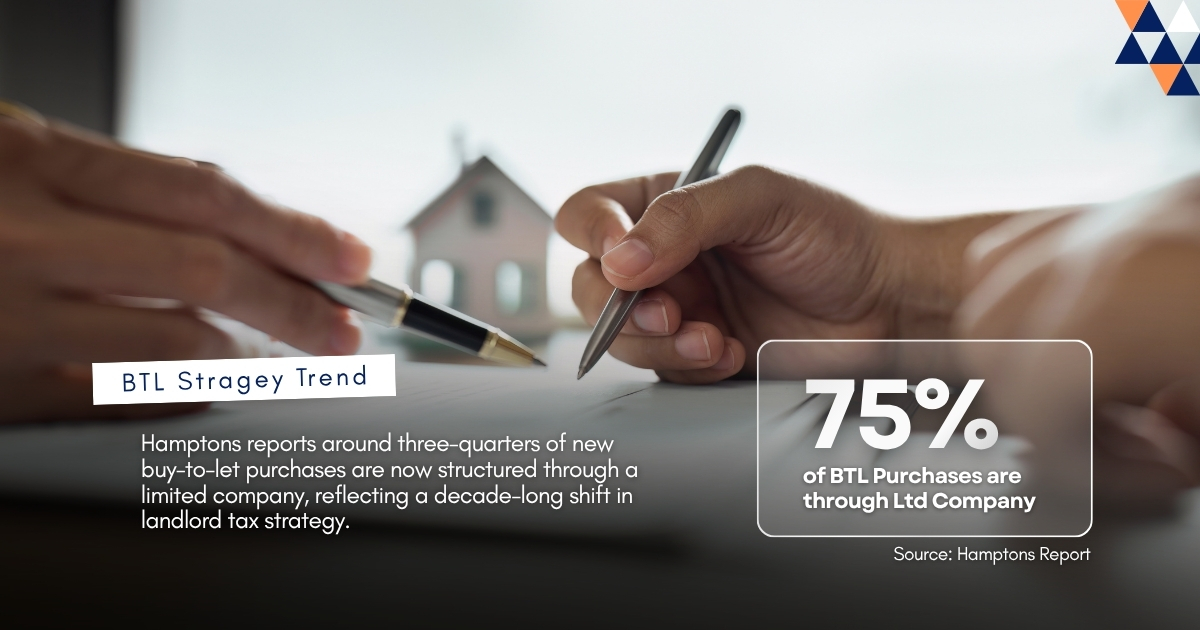
Limited company buy-to-let has gone from a niche structure to the default route for new entrants. According to Hamptons' 2025 Lettings Index, a record 66,587 new buy-to-let companies were incorporated in 2025, with 5,922 added in January 2026 alone. Around three-quarters of new mortgaged buy-to-let purchases are now made through a limited company — a measure of where new entrants are heading, not of the existing stock of UK landlords (most legacy personal-name portfolios have stayed put because moving them into an SPV triggers Capital Gains Tax and SDLT).
This guide is the developer-direct buyer's version. We cover the tax mechanics, mortgage market, off-plan considerations, and the situations where a limited company is the wrong answer.
Key Takeaways
- 66,587 New SPVs in 2025: A record year for incorporations, with around 75% of new mortgaged buy-to-let purchases now routed through limited companies.
- Section 24 Drives the Shift: Personal-name landlords lost full mortgage interest relief in 2020; companies still treat interest as a deductible expense.
- 5% SDLT Surcharge Applies: Every limited company residential purchase above £40,000 attracts the 5% additional dwelling surcharge, even on the company's first property.
- Off-Plan Pairs Well With SPVs: The 18 to 36 month build window gives time to incorporate cleanly before legal completion.
1. Why Landlords Are Incorporating in 2026
The shift tracks the phased removal of mortgage interest relief for personal-name landlords. Section 24 of the Finance Act 2015 fully removed mortgage interest deductibility by April 2020. Personal-name landlords now receive only a 20% basic-rate tax credit on mortgage interest, regardless of their actual tax band.
Limited companies are not affected. Mortgage interest paid by a company remains a fully deductible business expense, and the company pays corporation tax on net profit, not gross rent. For higher-rate taxpayers with leveraged portfolios, the maths can be the difference between a paper profit and a real one.
The momentum is accelerating. Hamptons reports 5,922 new buy-to-let limited companies set up in January 2026 alone, 11% more than the same month last year.
Quick FAQ:
Q: I'm a basic-rate taxpayer. Does Section 24 actually affect me?
A: Not directly. Basic-rate taxpayers receive the same 20% credit they would have received as a deduction. The issue is gross rental income pushing you into the higher-rate band, at which point Section 24 starts costing you. Many smaller landlords incorporate as a precaution against future band drift.
2. Personal Name vs Limited Company: A Side-by-Side Comparison
| Factor | Personal Name | Limited Company (SPV) |
|---|---|---|
| Tax on rental profit | Income tax (20%, 40% or 45%) | Corporation tax (19% small profits, 25% main rate) |
| Mortgage interest | Restricted to 20% tax credit | Fully deductible as business expense |
| SDLT additional surcharge | 5% if not your only property | 5% on every purchase above £40,000 |
| Capital Gains Tax on sale | 18% / 24% on gains above allowance | Corporation tax on gain, then dividend tax to extract |
| Mortgage rates | Wider product range, generally cheaper | Narrower lender pool, typically 0.5–1% higher |
Corporation tax for 2026/27 is 19% on the first £50,000 of profit, 25% above £250,000, with marginal relief between. Most single-property SPVs sit at 19%.
The trade-off most investors underweight is the cost of extracting income. Profit retained in the SPV pays only corporation tax; profit distributed as dividends pays dividend tax on top. If you intend to spend the rental income, that second layer matters. If you intend to reinvest, it does not.
3. SDLT, ATED and Other Costs to Plan For
Limited companies attract additional costs that personal-name buyers do not. The additional dwelling surcharge increased from 3% to 5% on 31 October 2024, and it applies to every residential property a company buys above £40,000, not just second properties.
For purchases above £500,000, a separate 17% flat rate can apply. From 31 October 2024, companies pay 17% SDLT as a flat rate on the entire purchase price. Property rental business relief is available for genuine buy-to-let companies, which puts the standard rates plus 5% surcharge back in scope — but the claim must be made correctly through the SDLT return.
Companies holding UK residential property above £500,000 also fall within the Annual Tax on Enveloped Dwellings (ATED) regime. For 2026/27, annual charges range from £4,600 to £303,450. Property rental business relief is again available, but must be claimed via the annual return by 30 April each year.
Quick FAQ:
Q: If most rental businesses qualify for relief, why does the 17% rate exist?
A: It exists primarily to deter the use of corporate envelopes for personal occupation of high-value homes. Genuine rental businesses are not the target, but landlords still have to claim the relief correctly.
4. Getting a Buy-to-Let Mortgage as a Limited Company
The SPV mortgage market is narrower than the personal-name market. Most mainstream lenders focus on personal-name buy-to-let; the SPV market is led by specialists such as Paragon, Aldermore, Kent Reliance, Landbay and Foundation Home Loans. Rates are typically 0.5–1.0% higher.
Lenders typically require a standalone SPV with a property-focused SIC code, personal guarantees from directors, and rental income covering 125% of mortgage interest at the lender's stress rate. For new-build apartments, some lenders apply additional restrictions on single-development exposure or minimum unit size. A specialist broker familiar with the SPV market is genuinely useful — appetite varies sharply between lenders.
Quick FAQ:
Q: Can I lend my own money into the SPV to fund the deposit?
A: Yes. Most SPV landlords fund the deposit via a director's loan from themselves to the company. The loan can be repaid tax-free as profits are generated, which is one of the SPV's quietest advantages.
5. Buying Off-Plan Through an SPV
Off-plan new-build pairs cleanly with limited company structures, and in some ways more cleanly than resale purchase.
A typical off-plan reservation requires a deposit within 28 days, contract exchange within a similar window, and legal completion 18 to 36 months later. That gap gives you time to incorporate the SPV, open a company bank account, and put any director's loan documentation in place before completion. A resale purchase rarely gives you more than 8 to 12 weeks, which is tight if the SPV does not already exist.
Three off-plan-specific considerations:
Reserve in the SPV's name from the start. Reserving in your personal name with the intention of "assigning to the company" later is generally a bad idea. The assignment may itself trigger SDLT, and developers' contracts often restrict assignment.
Plan stage-payment cash flow. Most off-plan structures are 10% at exchange and 90% on completion, but some require additional tranches at structural milestones. The SPV needs funded reserves for each.
Practical vs Legal Completion. The two events can be weeks or months apart. Mortgage drawdown, tenanting and the income stream all hinge on legal completion. Make sure the SPV's accounting period reflects that date.
Quick FAQ:
Q: Should I incorporate the SPV before I reserve, or after?
A: Before. Reservation contracts are usually exchanged in the name of the eventual buyer, and changing that later is administratively painful. Basic SPV formation costs £12 to £100 and the company can sit dormant until you complete.

6. When a Limited Company Is NOT the Right Answer
Limited company buy-to-let is not always the right structure. The headlines miss this regularly. The SPV route is generally a worse fit for:
- Basic-rate taxpayers with a single property bought outright or with low gearing. Section 24 has little impact, and the SPV's additional admin and mortgage cost outweigh the benefits.
- Investors who need the rental income for living expenses. Dividend tax on top of corporation tax creates a real drag if the money never gets reinvested.
- Anyone with an existing personal-name property they want to move into the SPV. The transfer counts as a sale and triggers both Capital Gains Tax and SDLT. The numbers rarely work for single-property landlords.
Get tax-specific advice from a qualified accountant before incorporating. This article is structural overview, not personal advice.
Explore: Manchester Major Areas Analysis
Manchester is the most active developer-direct market for limited company buy-to-let investors in 2026, with completed new-build apartments offering strong yields and a deep tenant base. Browse our Manchester area guide to see the current portfolio available for SPV purchase, or speak to our team about structuring an off-plan acquisition through a limited company.

How Rothmore Property Can Help
Rothmore Property is an award-winning UK estate agency specialising in new-build investment apartments across Manchester, Birmingham, Leeds and London. We work directly with developers to give investors access to off-plan and completed stock, and our team regularly supports clients buying through limited company structures.
If you are considering a limited company buy-to-let purchase, get in touch for a personalised conversation about which developments fit the structure best. We will not give you tax advice — that is your accountant's job — but we can talk you through the developer-direct buying process and which schemes have the strongest appetite from SPV lenders.
Frequently Asked Questions
The upfront cost is generally higher because of slightly higher mortgage rates, additional formation and accounting fees, and the 5% SDLT surcharge applying to every purchase above £40,000. The long-run tax position usually offsets these costs for higher-rate taxpayers with leveraged portfolios, but not for basic-rate taxpayers with cash purchases.
Ethan Wu
Senior Marketing Executive
Ethan is a Marketing Executive at Rothmore Property, bringing 4 years of experience spanning above-the-line marketing strategy, graphic design, and data-driven campaign analysis. Holding a Bachelor's degree in Marketing, Ethan oversees the full end-to-end marketing function at Rothmore — from market research and strategic planning through to creative production, campaign execution and performance reporting.
His analytical approach and design capability ensure every campaign is both visually compelling and grounded in measurable results, helping Rothmore maintain a consistent and impactful presence across all channels.
How can Rothmore Property help?
Whether you're an investor or a homeowner, Rothmore Property provides expert guidance, market insights, and tailored solutions to support your property purchase.


